
Correctly interpreting AirDNA data for the Charlotte, NC market is the most critical skill for a short-term rental (STR) investor. While platforms like AirDNA and PriceLabs provide an essential starting point, their headline revenue numbers can be misleading without proper context. The key is to move beyond the "average" and underwrite your investment based on top-quartile (75th percentile) performance, a specific competitive set, and a deep understanding of Charlotte's unique seasonality and demand drivers.
My name is Hemang Bhatt, and at my company Stayvanah, we provide professional short-term rental co-hosting services for investors in Charlotte. As a licensed North Carolina real estate agent with eXp Realty, I've helped numerous clients use data not just for projections, but to build a concrete business plan for high-performing assets. This guide explains how to analyze AirDNA Charlotte data like a professional operator to avoid common pitfalls and make confident investment decisions.
Why AirDNA's "Average" Revenue Is a Dangerous Benchmark
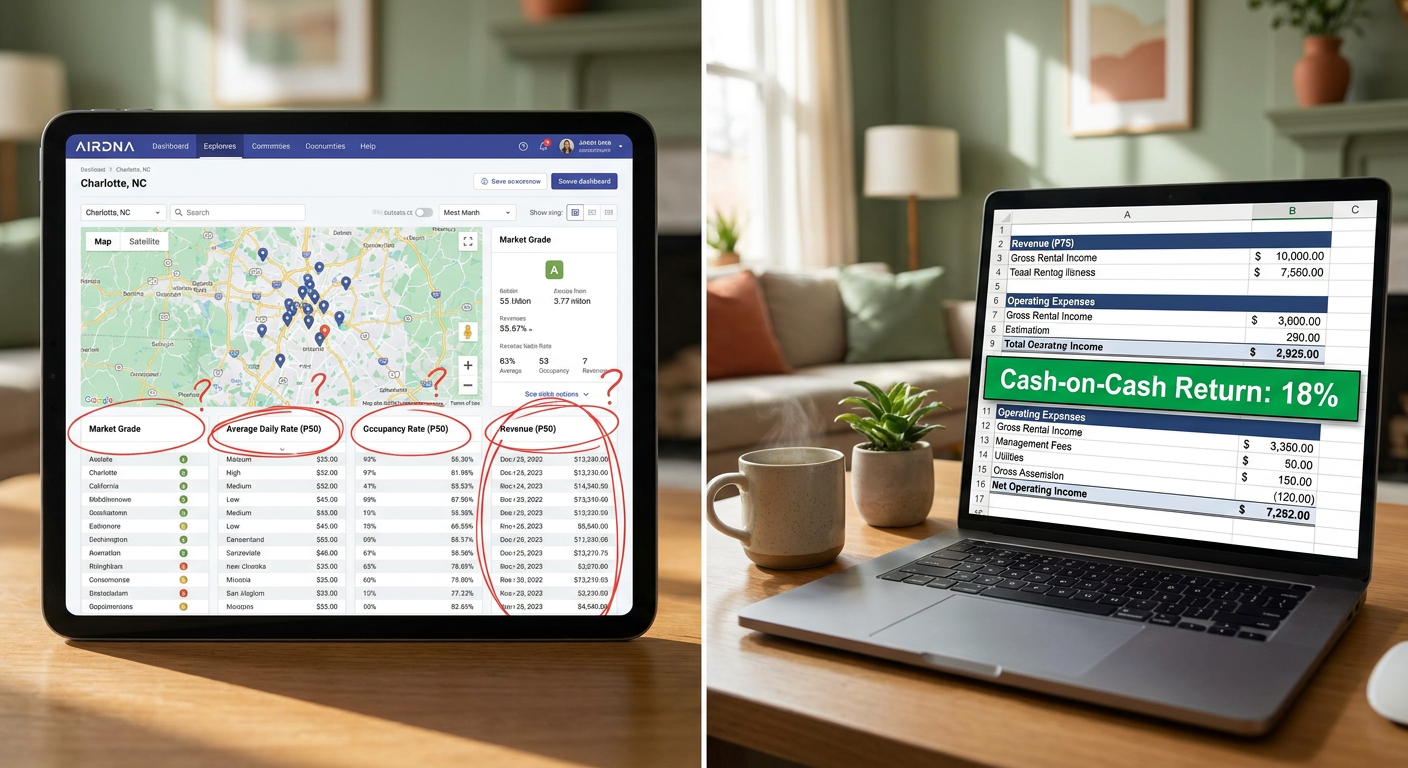
The most common mistake new investors make is building their pro forma around the 50th percentile (P50), or "average," revenue figures shown on AirDNA. This "average" includes every type of listing, from brand-new, professionally designed properties to tired, poorly managed rentals with bad photos and slow host response times. Aiming for average means you are planning for mediocrity, which is a failing strategy in a competitive market like Charlotte. Your goal as a serious investor is to compete with the best.
At Stayvanah, we exclusively benchmark performance against the 75th percentile (P75) and above. These are the top-quartile properties that are well-designed, strategically priced, and professionally operated. When you underwrite a potential investment, you must base your revenue projections on this P75 data set of truly comparable properties. This is the first and most important step in building a realistic financial model for your potential Charlotte STR investment.
Charlotte Short-Term Rental Property Management, Delivered as Co-Hosting
Investors often search for "Charlotte short-term rental property management," but what they truly need is a partner focused exclusively on the unique demands of STRs—which is fundamentally different from long-term rental management. This is where Stayvanah's co-hosting model shines. As your co-host, we deliver all the services of a top-tier manager, but you, the owner, keep the title, the Airbnb/VRBO listing, the review history, and direct access to the payouts. It’s your asset, and you remain in control.
Our approach avoids the pitfalls of traditional property management:
- Owner Stays in Control: You own the listing and the account. Your reviews and Superhost status are yours to keep, forever.
- No Lock-In Contracts: We operate on a flexible agreement that earns your business every month.
- Transparent Fees: We charge a simple, flat 18% of gross booking revenue. No hidden fees for "leasing," "maintenance coordination," or other upcharges common in traditional PM models.
- STR-Native Operations: Our entire playbook—from dynamic pricing and 24/7 guest communication to turnover management—is built from the ground up for short-term rentals, not adapted from a long-term lease model.
This operational excellence is how we aim to outperform the P75 data you see on AirDNA. Our co-hosting services are designed to maximize your revenue and guest satisfaction.
How to Underwrite a Charlotte STR Using AirDNA Data
An AirDNA report is a research tool, not a business plan. Here’s a step-by-step guide to translating that raw data into a confident investment decision for a property in a neighborhood like NoDa, Plaza Midwood, or South End.
Step 1: Define Your True Competitive Set
To get a credible revenue projection, you must compare your subject property only to those that are truly similar. A 2-bedroom bungalow in Optimist Park is not in the same competitive set as a 5-bedroom luxury home in Dilworth. Use AirDNA's map and filters to create a hyper-specific list of 10-15 properties.
| Filter By | Criteria | Why It Matters | | :--- | :--- | :--- | | Location | Same neighborhood, similar proximity to demand drivers | A few blocks can make a huge difference in guest appeal. | | Property Type | House vs. Apartment vs. Townhouse | Guests filter by property type; your analysis must too. | | Bed/Bath Count | Identical | This is the most fundamental property characteristic. | | Guest Count | Similar maximum occupancy | Directly impacts potential booking size and revenue. | | Amenities | Pool, hot tub, fenced yard, dedicated parking | Must compare like-for-like on major guest-attracting amenities. | | Review Score | 4.8+ Only | Model your investment against top performers, not laggards. |
Once you have this focused comp set, then you can use the P75 revenue data as a credible top-line projection for your financial model.

Step 2: Model Charlotte's Seasonality and Compression Events
A single annual revenue number hides the crucial story of when that money is made. Understanding Charlotte's specific seasonal demand and event-driven revenue spikes is key to sophisticated underwriting and is a core part of our service offerings.
- High Season (Mar-Jun, Sep-Oct): Driven by great weather, festivals (like the North Carolina Azalea Festival), and strong corporate travel.
- Shoulder Season (Jul-Aug, Nov): Summer heat and holiday travel shifts demand, requiring pricing adjustments.
- Low Season (Jan-Feb): Post-holiday slowdown necessitates strategies like targeting mid-term stays.
More importantly, your model must account for "compression events"—specific dates that cause demand and rates to surge. A professional operator’s revenue strategy is built to maximize these.
- Carolina Panthers home games
- Major concerts at Bank of America Stadium or Spectrum Center
- UNC Charlotte and Queens University events (graduations, parents weekend)
- Large conventions (e.g., at the Charlotte Convention Center)
- NASCAR races at Charlotte Motor Speedway in nearby Concord
Relying on a simple annual average completely misses the revenue potential of these key dates.
Step 3: From Gross Revenue to Cash-on-Cash Return
That P75 annual revenue projection is just the beginning. The real analysis comes from accurately forecasting expenses to determine your actual profit. Many investors fail by underestimating costs.
-
Calculate Operating Expenses: This is everything required to run the property. Be thorough.
- Management/Co-Host Fee: Budget 18-25% of gross revenue. Stayvanah charges a transparent 18%.
- Taxes: North Carolina sales tax + Mecklenburg County occupancy tax.
- Insurance: You need a specific STR policy, which costs more than a standard homeowner's policy.
- Utilities: Internet, electricity, gas, water, waste management.
- Consumables & Supplies: Coffee, toiletries, paper products, cleaning supplies.
- Maintenance & Repairs: A good starting point is 1-2% of the property value annually.
- Software: Your portion of subscriptions for pricing tools (PriceLabs), channel managers, etc.
-
Find Net Operating Income (NOI): Gross Projected Revenue - Total Operating Expenses = NOI. This is the property's profit before your mortgage.
-
Determine Cash-on-Cash (CoC) Return: This is the ultimate measure of your investment's performance. A strong CoC return for a Charlotte STR is typically 15-20% or higher. You can get a personalized projection using our free property return estimate tool.
- Total Cash Invested: Down Payment + Closing Costs + Furnishing & Setup Costs.
- Annual Cash Flow: NOI - Annual Mortgage Payments.
- Cash-on-Cash Return: (Annual Cash Flow / Total Cash Invested) x 100.
Successfully using AirDNA for Charlotte requires moving beyond the dashboard. It demands a rigorous, conservative approach to underwriting and a relentless focus on operational excellence. This data-driven process, combined with professional execution, is what separates a speculative purchase from a high-performing investment asset.
Frequently Asked Questions
### How much does a short-term rental property manager in Charlotte cost?
While some traditional property managers charge 20-30% with added fees, Stayvanah operates on a more investor-friendly co-hosting model with a transparent, flat 18% of gross booking revenue. This fee covers all our core services, from dynamic pricing and guest communication to coordinating turnovers, without the hidden charges common in the industry.
### Is AirDNA's "Rentalizer" estimate accurate for Charlotte?
The Rentalizer tool is a good starting point for a quick, high-level assessment, but it should never be the basis for a final investment decision. It often lacks the nuance of a true competitive set analysis and may not fully account for hyper-local neighborhood differences or the quality of a specific property. For a serious analysis, you must perform the manual comp set and underwriting process described above. As a real estate agent and co-host, I can help you with this more detailed analysis—you can learn more about me at my real estate site, hbmcre.com/hemang-bhatt/.
### What is a good cash-on-cash return for an Airbnb in Charlotte?
For a well-located, professionally managed and designed short-term rental in the Charlotte market, investors should target a cash-on-cash (CoC) return of 15% to 20% or higher. Achieving this requires accurate revenue and expense projections from the start, strategic property acquisition, and excellent operations to outperform the market average and hit those top-quartile performance numbers.
Written by Hemang Bhatt, Charlotte STR realtor and founder of Stayvanah — licensed North Carolina real estate agent with eXp Realty.
Ready to take the next step?
If you own a Charlotte-area property — or you're considering buying one — Stayvanah can give you a real-numbers picture of what it would earn as a short-term rental. We deliver Charlotte short-term rental property management as co-hosting: you keep the title, the listing, and the payouts.
👉 Get your free earnings estimate
Prefer to talk it through? Schedule a call with Hemang — founder of Stayvanah and a licensed NC real estate agent specializing in STR.