The rules for operating a short-term rental (STR) in Charlotte, NC, primarily require that the property be the host's "primary residence." My name is Hemang Bhatt, and at Stayvanah, my co-hosting company, we navigate these regulations daily. This means to legally host on Airbnb or Vrbo in most residential zones, you must live in the home for the majority of the year; you can rent out your entire home when you travel or rent a spare room while you are there, but you generally cannot buy a property solely for full-time STR use.
This guide breaks down the essential laws, permits, and zoning rules you must follow to build a sustainable and legal STR business in the Charlotte market. As a licensed North Carolina real estate agent with HBMCRE and eXp Realty, I help investors understand these rules before they even buy. Stayvanah then provides the co-hosting services to ensure your property remains compliant from day one.
Is Your Property Eligible for STR Use in Charlotte?
The first step is determining if your property can legally be used as a short-term rental. The City of Charlotte amended its Unified Development Ordinance (UDO) in 2023, and the single most important factor is the primary residence requirement, which was designed to balance tourism with residential neighborhood stability.
The Primary Residence Requirement Explained
A "primary residence" is the address where you live most of the year, as proven by your driver’s license, voter registration, or tax documents. This rule, enforced by Mecklenburg County, effectively prohibits investors from purchasing homes in most residential zones (like NoDa, Plaza Midwood, or Dilworth) to operate as full-time, year-round Airbnbs where the owner doesn't live. The goal was to stop neighborhoods from becoming de facto hotel zones.
You can still:
- Rent your entire primary home when you are out of town.
- Rent a private room, an attached suite, or an accessory dwelling unit (ADU) on your primary residence property while you are living there.
Some zoning districts, typically in denser, multi-family or mixed-use areas like South End or parts of Uptown, may permit non-primary residence STRs. However, verifying the specific zoning for the exact property parcel is a critical due diligence step. At HBMCRE, this zoning check is one of the first things we do when evaluating a potential investment property for a client.

How to Get Your Charlotte STR Permit
Once you confirm your property is eligible, you must obtain a Zoning Use Permit for a Short-Term Rental. Operating without this permit is a violation that leads to fines and a potential ban from hosting. While some investors search for "Charlotte short-term rental property management," what they really need is a partner who handles this compliance from the start. Stayvanah delivers this as a co-host—you keep the title, the listing, and the payouts, and we manage the operational details like permitting.
The Permit Application Process
The application is managed online through the Mecklenburg County Code Enforcement portal. Here is a summary of the steps:
- Gather Documents: You will need proof of primary residency, such as a government ID, utility bill, or tax bill with the property's address. You also need a simple site plan showing guest parking and the rented areas.
- Complete the Online Application: Fill out the form with accurate details about your property and management plan.
- Pay the Fee: The application fee was $75 as of late 2023. This is a small but essential cost for legal operation.
- Possible Inspection: The city may inspect your property for basic safety standards like working smoke detectors and clear egress paths.
Securing this permit is the absolute foundation of a legal STR business in Charlotte. Our co-hosting services manage this entire process for our owners to ensure they are fully compliant before the first guest checks in.
Overlays and HOAs: The Other Rulebooks
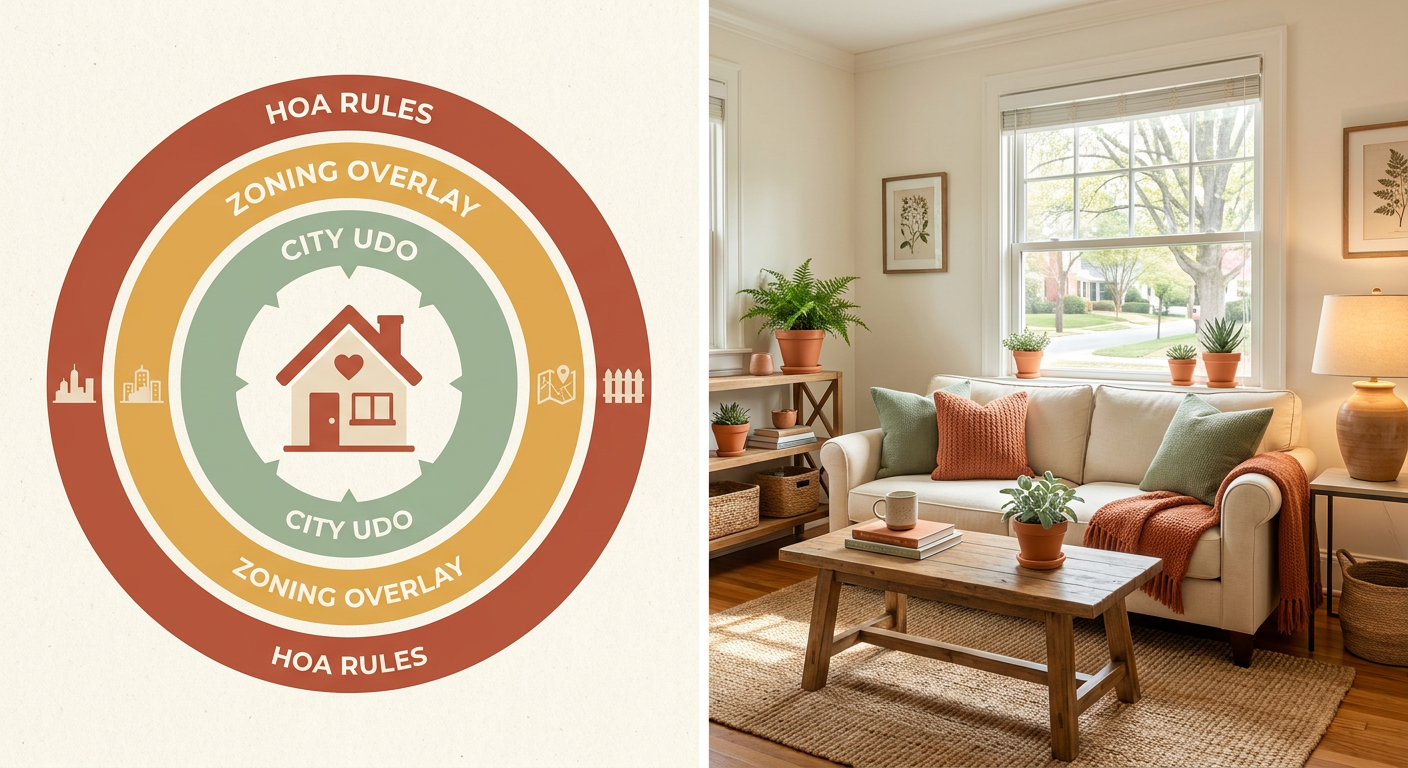
Even with an STR permit from the city, two other layers of regulations can prohibit your rental activity: zoning overlay districts and Homeowner Association (HOA) rules.
Zoning Overlay Districts
Charlotte applies "overlay districts" to add special rules to certain neighborhoods on top of the base zoning. A historic district overlay in Elizabeth might restrict renovations, while other overlays in different areas may explicitly ban short-term rentals, even if the primary residence rule is met. You must check the city’s official online zoning map for your specific address to see if any overlays apply. This is a common and expensive mistake for new hosts.
Homeowner Association (HOA) Rules
If your home is in a community with an HOA, its rules (called Covenants, Conditions, and Restrictions, or CC&Rs) can legally forbid STR operations. HOA bylaws almost always supersede city zoning ordinances. If your HOA documents specify a minimum lease term of six or twelve months, that legally prevents you from hosting on Airbnb or Vrbo. Many new hosts get their city permit only to receive a cease-and-desist letter from their HOA. As a licensed real estate agent, I always stress to my clients that reviewing HOA documents is as crucial as the home inspection itself.
Ongoing STR Compliance in Charlotte
Launching your STR is just the beginning; staying compliant is an ongoing responsibility.
| Compliance Task | Description | | :--- | :--- | | Permit Renewal | Your STR permit requires annual renewal. This includes re-confirming that the property is still your primary residence. | | Occupancy Tax | You must collect and remit occupancy taxes to Mecklenburg County and the State of North Carolina. Airbnb and Vrbo often automate this, but you are ultimately responsible for ensuring it's paid correctly. | | Neighborhood Impact | Manage noise, trash, and parking to be a good neighbor. The city's regulations exist because of resident complaints, so responsible hosting is key to protecting your investment and the local industry. |
Navigating Mecklenburg County zoning and Airbnb regulations in Charlotte requires diligence. While the primary residence rule has reshaped the landscape, it has created a market that favors responsible, local operators—the exact model Stayvanah was built for. If this sounds complex, don’t worry. Our role as your co-host is to manage every one of these details. Get a free revenue estimate on our site to see what your property could earn by clicking here.
Frequently Asked Questions
Can I buy a house in Charlotte just for Airbnb?
Generally, no. Due to the "primary residence" requirement in Charlotte's Unified Development Ordinance (UDO), you cannot operate a full-time short-term rental in most residential zones unless you live in the property. You must prove it is your main home.
What is the difference between a property manager and a co-host?
The main difference is that with co-hosting, you, the owner, stay in control. Hemang Bhatt and Stayvanah operate as a co-host, meaning you keep your property title, your Airbnb/Vrbo listing, and all booking revenue is paid directly to you. We manage all operations for a transparent flat fee, avoiding the complex fee structures and contract lock-ins of traditional property management.
What happens if I run an Airbnb without a permit in Charlotte?
Operating an STR in Charlotte without the required Zoning Use Permit can lead to fines from Mecklenburg County Code Enforcement, a temporary or permanent ban on hosting, and being delisted from platforms like Airbnb and Vrbo. It is not worth the risk.
Written by Hemang Bhatt, Charlotte STR realtor and founder of Stayvanah — licensed North Carolina real estate agent with eXp Realty.
Ready to take the next step?
If you own a Charlotte-area property — or you're considering buying one — Stayvanah can give you a real-numbers picture of what it would earn as a short-term rental. We deliver Charlotte short-term rental property management as co-hosting: you keep the title, the listing, and the payouts.
👉 Get your free earnings estimate
Prefer to talk it through? Schedule a call with Hemang — founder of Stayvanah and a licensed NC real estate agent specializing in STR.