To determine if converting a long-term rental (LTR) to a short-term rental (STR) in Charlotte is profitable, you must calculate your "STR Break-Even Occupancy." This is the occupancy rate your STR needs to achieve just to match your LTR's net income after accounting for the STR's significantly higher and more complex operating costs. My name is Hemang Bhatt, and at Stayvanah, my co-hosting company, we use this exact framework to help Charlotte real estate investors make data-driven decisions before converting a property. This analysis is the crucial first step before considering a switch.
At Stayvanah, we specialize in Charlotte short-term rental property management, delivered through a co-hosting model. This means you, the investor, keep ownership of your property, your Airbnb or Vrbo listing, and all the valuable review history. I, Hemang Bhatt, also a licensed real estate agent with eXp Realty, help investors acquire, design, and operate these properties. Our goal is to provide a clear financial picture, and that starts with an honest look at the numbers.
LTR vs. STR: Understanding the New Operating Costs
The primary allure of an STR is its potential for higher gross revenue, but this is only half the story; net profit is what matters. Converting from an LTR to an STR means shifting from being a landlord to being a hospitality operator, and the expenses reflect this. You must account for a completely different cost structure before you can accurately compare the two models.
Key differences in operating costs include:
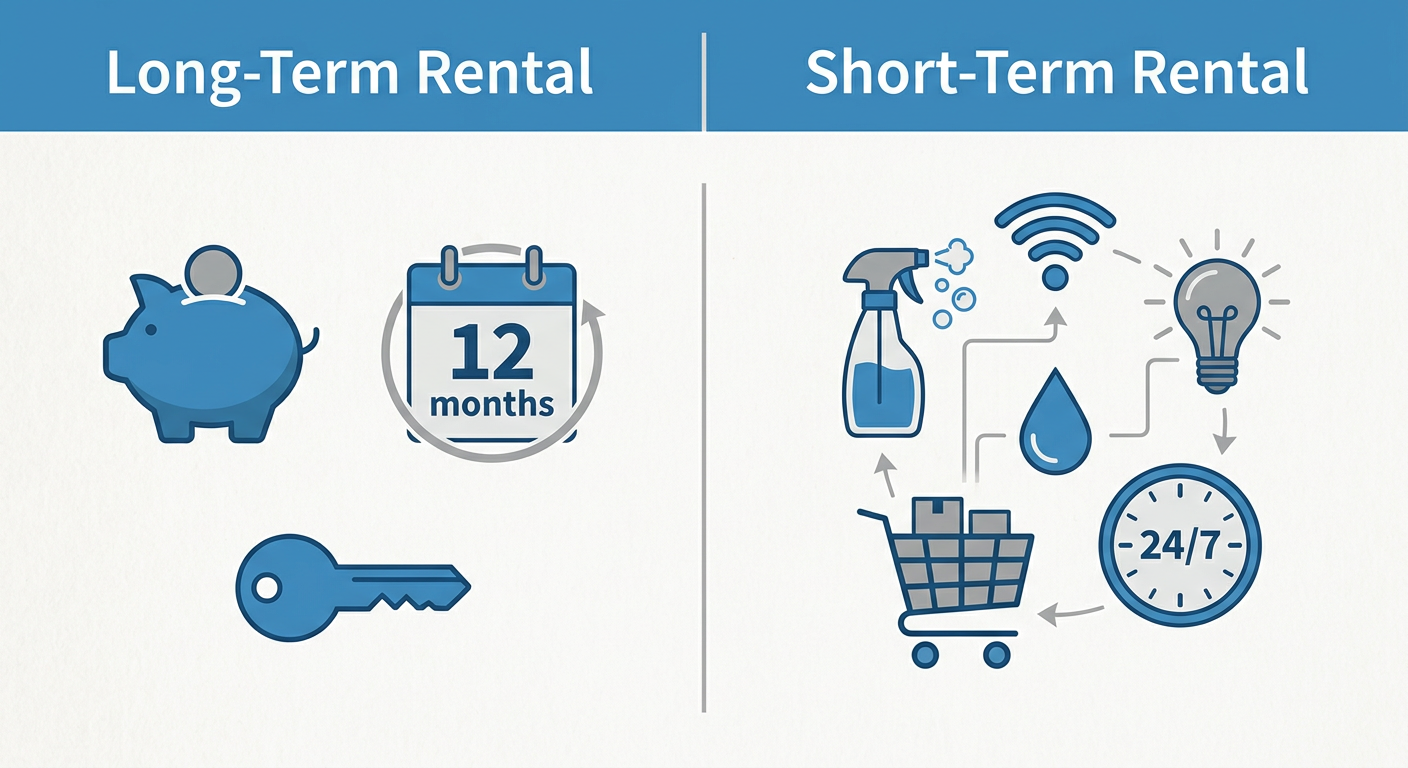
- Long-Term Rental (LTR): Your costs are predictable. They primarily consist of the mortgage, property taxes, insurance, and occasional maintenance. You might budget for vacancy and management, but the month-to-month expenses are relatively stable.
- Short-Term Rental (STR): Your costs are variable and substantially higher. You are now responsible for all utilities (internet, electricity, water, gas, landscaping), professional cleaning between every guest, restocking consumable supplies (coffee, paper towels, soap), platform fees (e.g., Airbnb/Vrbo), and specialized STR insurance. This operational complexity is why many investors seek expert help rather than self-managing.
The Break-Even Framework for an LTR to STR Conversion
To make an informed decision, let's walk through the exact steps to calculate your break-even occupancy. This framework moves from vanity (gross revenue) to sanity (net profit).
Step 1: Calculate Your Current LTR Net Income
First, establish your baseline. This is the annual profit your property generates as a long-term rental. Be thorough and honest about your expenses.
- Gross Annual Rent: Monthly Rent x 12
- Annual Expenses: Include property taxes, insurance, HOA fees, a vacancy fund (typically 5% of gross rent), a maintenance fund (5-10%), and any long-term property management fees.
LTR Net Annual Income = Gross Annual Rent - Total Annual Expenses
For a 2-bedroom home in a neighborhood like Plaza Midwood renting for $2,200/month:
- Gross Annual Rent: $26,400
- Example Annual Expenses: ~$7,600 (including taxes, insurance, and funds for vacancy/maintenance)
- LTR Net Annual Income: $18,800
This $18,800 is the target your STR must beat to be considered a financial success.
Step 2: Estimate Your STR Gross Potential Revenue
Next, project the top-line revenue your property could generate as an STR. This requires real market research using tools like AirDNA or by manually checking comparables.
- Identify Comps: Find 5-10 similar properties on Airbnb and Vrbo in your specific Charlotte neighborhood (e.g., South End, NoDa, Dilworth).
- Analyze Pricing: Look at their nightly rates, noting differences for weekdays, weekends, and seasons. Check their future calendars to gauge booking pace.
- Determine a Realistic Average Daily Rate (ADR): Based on your research, establish a conservative, blended ADR. For our Plaza Midwood example, let's assume an ADR of $180/night.
Your absolute best-case-scenario income, assuming 100% occupancy, would be $180 ADR x 365 days = $65,700. You will not achieve this, but it is the starting point for our calculation.
Step 3: Project Your Total STR Annual Expenses
This is the most critical and often underestimated part of the analysis. It includes a large one-time setup cost and significantly higher ongoing operational costs.
| Expense Category | Description & Estimated Cost (Charlotte, NC) | | --- | --- | | One-Time Setup | Furnishing and equipping a 2-bedroom property from scratch. $15,000 - $30,000+ | | Variable Costs | Cleaning fees ($120/turnover), restocking supplies ($20/turnover), platform fees (~3%). These depend on occupancy. | | Fixed Costs | Utilities ($400-$600/mo), STR insurance, software subscriptions (e.g., PriceLabs), landscaping, pest control. ~$12,000/year |
Using these figures, we can estimate total annual STR costs. Assuming an average of 6 turnovers per month for a moderately successful property: (6 turnovers x ($120 cleaning + $20 restocking)) x 12 months = $10,080. Add this to the fixed costs:
Total Estimated Annual STR Operating Costs ≈ $12,000 (fixed) + $10,080 (turnover-based) = $22,080
Note: This calculation excludes the co-hosting fee, which is a percentage of revenue.

Step 4: Calculate Your Break-Even Occupancy
Now we combine everything to find the magic number. First, determine the total revenue needed to match your LTR's profit after covering the new STR costs.
- Break-Even Revenue = LTR Net Income + Total Annual STR Operating Costs
- $18,800 + $22,080 = $40,880
This is the amount of booking revenue your STR must generate to be in the exact same financial position as your LTR. Next, we determine how many nights you need to book to earn this.
-
Net Revenue Per Booked Night = ADR - Platform Fee
-
$180 - ($180 x 3%) = $174.60
-
Break-Even Nights = Break-Even Revenue / Net Revenue Per Booked Night
-
$40,880 / $174.60 ≈ 234 nights
Finally, we convert this to the break-even occupancy rate.
- Break-Even Occupancy = Break-Even Nights / 365 Days
- 234 / 365 ≈ 64%
Conclusion: In this example, you need to be booked for 64% of the year just to match your LTR's profit. With average occupancy in Charlotte often hovering in the 65-75% range, this shows that the profit margins are not automatic. Success depends on pushing both ADR and occupancy above market averages through professional operations, dynamic pricing, and superior guest experience—which is the core value a co-host like Stayvanah provides through our co-hosting services.
Beyond the Numbers: Is the STR Model Right for You?
This financial analysis is step one, but a successful conversion also depends on your goals and capacity. Are you prepared for the 24/7 demands of hospitality, from late-night guest questions to coordinating emergency maintenance? This is the primary reason investors partner with a co-host. We absorb the operational workload, allowing you to benefit from the investment without the day-to-day grind.
Furthermore, consider the regulatory environment, including the City of Charlotte short-term rental registration and Mecklenburg County occupancy tax requirements. The flexibility to use your own property is a great perk, but it comes with the trade-off of more volatile income compared to a 12-month lease. If you're considering acquiring a property for this purpose, my expertise as a Charlotte STR Realtor can be invaluable.
Making the decision to convert your LTR is a major strategic move. The goal of this framework is to empower you to make that decision with clarity and confidence. If you'd like a custom analysis for your specific property, you can request a free revenue estimate on our site.
Frequently Asked Questions
### What is the biggest mistake owners make when converting an LTR to an STR?
The biggest mistake is underestimating the total operating costs and the personal time commitment required. Owners often focus on the high potential nightly rates but fail to budget for furnishing, all utilities, frequent cleanings, supplies, higher insurance, and the 24/7 nature of guest communication, which leads to lower-than-expected net profits.
### Is it better to self-manage my STR conversion or hire a co-host?
If you have significant free time, live close to the property, and have experience in hospitality and marketing, self-management can be rewarding. However, if you want to maximize revenue and minimize personal effort, hiring a co-host like Stayvanah is more effective. We handle all operations, from dynamic pricing and marketing to guest services and turnover management, for a flat fee of 18% of gross booking revenue.
### How much does it cost to furnish a house for Airbnb in Charlotte?
For a typical 2-bedroom home in Charlotte, you should budget between $15,000 and $30,000 to fully furnish and equip it for a short-term rental. This includes all furniture, mattresses, linens, kitchenware, smart TVs, decor, and outdoor amenities. The cost can vary based on the quality of finishes and the size of the property. Stayvanah also offers STR design services to manage this entire process for investors.
Written by Hemang Bhatt, Charlotte STR realtor and founder of Stayvanah — licensed North Carolina real estate agent with eXp Realty.
Ready to take the next step?
If you own a Charlotte-area property — or you're considering buying one — Stayvanah can give you a real-numbers picture of what it would earn as a short-term rental. We deliver Charlotte short-term rental property management as co-hosting: you keep the title, the listing, and the payouts.
👉 Get your free earnings estimate
Prefer to talk it through? Schedule a call with Hemang — founder of Stayvanah and a licensed NC real estate agent specializing in STR.